1. Home
  2. Life & Biography

Life & Biography
1894 – 1934

Forty years, told in ten chapters. A schoolteacher from a village in Raozan becomes the organiser of the largest armed action against British authority in inter-war Bengal — and is hanged for it at thirty-nine.

Born 22 March 1894, Noapara Died 12 January 1934, Chittagong Chapters 10 Reading about 15 minutes

1894 · Noapara

01 1894 · Noapara

Chapter one Birth and early life

Surya Kumar Sen was born on 22 March 1894 at Noapara, in the Raozan area of Chittagong district. The district then lay at the south-eastern edge of the Bengal Presidency of British India; since 1971 it has been part of Bangladesh, and the city is today officially spelled Chattogram.

His family was Bengali and of modest means. His father was a teacher — a detail worth holding on to, since teaching would define his son’s public identity as completely as politics later did. Published sources give the father’s name differently, and this site does not pick a winner between them; the profession is consistently reported, the name is not.

Very little else about his childhood is securely documented. The intimate anecdotes that circulate about his early years generally trace back to memoirs written decades afterwards by people who admired him, and they are best read as tribute rather than as record.
1916 · Berhampore

02 1916 · Berhampore

Chapter two Education, and the turn

1916

Sen left Chittagong to read for a BA at Berhampore College in Murshidabad — today Krishnath College. It was there, in 1916, that a teacher named Satish Chandra Chakrabarti introduced him to nationalist politics and, through it, to the revolutionary underground.

The recruitment is the hinge of his life, and its shape is telling: it happened inside an institution, through a teacher, to a student. That pattern — the classroom as the recruiting ground — is the one Surya Sen would later reproduce in Chittagong with almost mechanical consistency.

The organisation he joined was the Anushilan Samiti, one of the two great Bengali revolutionary societies formed in the wake of the 1905 partition. He later moved within the orbit of Jugantar, the group that had split from Anushilan and operated more loosely.

Both organisations shared a founding premise: that constitutional agitation alone would not dislodge British rule, and that a disciplined secret society could. What they actually achieved in Bengal remains one of the genuinely contested questions in the historiography of the independence movement.

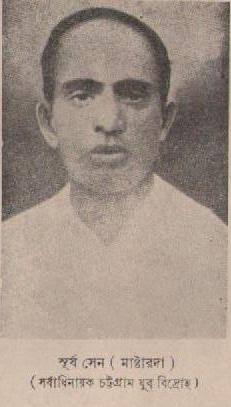
Plate 02 Archival printed portrait of Surya Sen with a printed Bengali caption beneath it identifying him as Masterda and as leader of the Chittagong youth uprising.
Archive · printed portrait A halftone portrait as reproduced in print, with a Bengali caption below the image.

Reading the plate

How he was captioned

The printed Bengali caption beneath this portrait carries two lines. The first names him: Surya Sen (Masterda). The second describes his position: Sarbadhinayak — supreme leader — of the Chattagram Jubo Bidroha, the Chittagong youth uprising.

That is a useful piece of evidence in itself. It shows how the events of April 1930 were being named in Bengali print: not as a raid or a crime, which is how the colonial record described them, but as a bidroha, a revolt, carried out by the young. The vocabulary a document uses is part of what the document tells you.

1918 · Chittagong

03 1918 · Chittagong

Chapter three The teaching career, and a name

In 1918 Sen came to Chittagong and began teaching at a national school in the town. National schools were themselves a political product — institutions founded during the Swadeshi years as an alternative to government education, staffed by men who had often declined official careers on principle.

His students called him Masterda. The word joins the English master, in the sense of schoolmaster, to the Bengali da, the familiar suffix for an elder brother. It is affection and hierarchy in a single word, and it stuck: in Bengali writing about the Chittagong movement he is more often Masterda than Surya Sen.

The teaching was not a cover story. He appears to have gone on teaching while organising, and the school gave him what any underground movement needs most and can least easily manufacture: a legitimate reason to spend long hours with a continuous supply of young people, and to know which of them could be trusted.

Humanism is a special virtue of a revolutionary.
Attributed to Surya Sen

This line is widely attributed to him in published accounts. Unlike the final letter of January 1934, it is not tied to a dated document, and it is presented here as an attribution rather than as a verified quotation.

1918–1922

04 1918–1922

Chapter four Congress, and the discipline of open politics

In the same year that he began teaching, 1918, Surya Sen became president of the Chittagong branch of the Indian National Congress. He was twenty-four. For the next several years he worked as a district-level Congress organiser, and he was active in the Non-Cooperation movement that Gandhi launched in 1920.

This period is often skipped in popular retellings, which prefer the straight line from teacher to gunman. It should not be. Non-Cooperation was where an entire generation of Indian activists learned logistics: how to run a district committee, hold a meeting under surveillance, raise money, print and distribute, and keep hundreds of volunteers moving in the same direction without a salaried structure.

Surya Sen’s later network was built with exactly those skills. When Non-Cooperation was abruptly suspended in February 1922 after the violence at Chauri Chaura, it left behind large numbers of trained, mobilised and severely disappointed young volunteers. In Chittagong, a number of them found their way to him.

December 1923

05 December 1923

Chapter five The railway treasury, and the money problem

In December 1923, Surya Sen took part with Ambika Chakrabarty in the robbery of the Assam-Bengal Railway treasury at Chittagong. It is his first documented armed action, and it was not symbolic. Secret organisations need money for weapons, travel, safe houses and the support of families whose earners are in jail, and they cannot raise it publicly.

Colonial records classified such actions as dacoity — armed robbery. The revolutionaries called them political actions. Both descriptions are accurate about different things, and the gap between them is precisely where the moral argument about the Bengal underground has always been conducted.

This site does not resolve that argument by adjective. What can be stated plainly is that the 1923 action was funding, that Ambika Chakrabarty was involved with him, and that the two men would still be working together seven years later on the night of the armoury raid.

It is also worth noting what did not follow. There is no evidence of a campaign of such robberies in Chittagong through the mid-1920s. The pattern of the group under Surya Sen was long preparation punctuated by rare action — the opposite of a gang.

1926–1928

06 1926–1928

Chapter six Two years inside

1926 1928

Surya Sen was imprisoned for two years, from 1926, and released towards the end of 1928. The detention belongs to a wider colonial practice: under the Bengal Criminal Law Amendment Act of 1925 and the ordinances around it, suspected revolutionaries could be held for extended periods without the evidentiary requirements of an ordinary criminal trial.

The policy was designed to decapitate the underground by removing its organisers. In Bengal it repeatedly produced the opposite effect. Prisons concentrated experienced revolutionaries in one place, introduced them to each other, and returned them to their districts with wider contacts and fewer illusions about the reach of the law.

Sen came out at the end of 1928 into a changed national situation. The Simon Commission, appointed in 1927 without a single Indian member, had inflamed opinion across the country; Congress was moving towards a demand for complete independence, which it adopted at Lahore in December 1929. Within eighteen months of his release, the Chittagong plan would be ready.

1929–1930

07 1929–1930

Chapter seven Building the network

What Surya Sen assembled in Chittagong between 1928 and 1930 was not a militia. It was a compartmented organisation of small groups, drawn overwhelmingly from students and young men in their late teens and twenties, that could hold a secret for long enough to act on it.

The group gave itself a name that announced its politics: the Indian Republican Army, Chittagong Branch. The choice of the word republican is not decorative. It placed the Chittagong group in the company of anti-colonial movements elsewhere that had claimed the authority of a provisional government rather than the status of rebels — a claim the group would make explicitly on the night of the raid.

Its leadership style is described consistently in the memoirs: authority held by consent, decisions taken collectively, and the leader personally unarmed for much of the operation. Those accounts come from admirers, and should be weighed accordingly. But the network’s behaviour under pressure — it survived arrests, executions and three years underground before it was finally broken — is independent evidence that the internal discipline was real.

Chapter eight

18 April 1930

The night the district changed hands

At about ten o’clock on the night of 18 April 1930, roughly sixty-five people moved on four objectives in and around Chittagong. The police armoury fell to a group under Ganesh Ghosh. The Auxiliary Force armoury fell to about ten men under Lokenath Bal. Telephone and telegraph communication was destroyed and railway movement disrupted. A fourth party of around sixteen went for the European Club at Pahartali and found it nearly empty.

At the police armoury, Surya Sen took a military salute, hoisted the national flag and proclaimed a Provisional Revolutionary Government. Then the plan met its limit: the raiders had rifles and could not find ammunition. Holding the town was impossible.

They withdrew into the hills. On 22 April 1930 British troops located them at Jalalabad hill and a sustained gunfight followed. Twelve revolutionaries were killed, among them Lokenath Bal’s younger brother Harigopal Bal. Figures given for British casualties vary considerably between sources and should be treated with care.

The survivors dispersed. Some were caught within months; some reached Calcutta; some stayed in the countryside around Chittagong and kept the movement alive for another three years.

The raid in six acts

1930–1933

09 1930–1933

Chapter nine Nearly three years underground

Surya Sen was not captured in the immediate aftermath of the raid. He remained at large in the Chittagong countryside for almost three years, moving between villages and sheltered by households prepared to take the risk of hiding him.

The movement continued in that period, and so did its losses. On 1 December 1930 Ramkrishna Biswas and Kalipada Chakrabarty attempted to kill a senior British police official named Craig and shot dead a railway inspector, Tarini Mukherjee, instead; Biswas was hanged at Alipore Jail on 4 August 1931. On 13 June 1932, at Dhalghat, a party led by Captain Cameron surrounded a house where Surya Sen was meeting comrades. Cameron was killed; Nirmal Sen and Apurba Sen died covering the escape of Surya Sen and the others.

On 24 September 1932, Pritilata Waddedar led the attack on the Pahartali European Club that had failed on the night of the raid. The building was set alight and fired into; one person was killed and eleven were injured. Wounded and cut off, Pritilata took potassium cyanide rather than be taken alive. She was twenty-one.

By the end of 1932 the network was under extreme pressure. It had lost its most experienced field commanders, its safe houses were being identified, and the reward offered for its leader was large enough to be worth someone’s conscience.

1933–1934

10 1933–1934

Chapter ten Capture, trial, execution

On 16 February 1933 Surya Sen was arrested at a house in the Gairala area of Chittagong district. He had been given away by Netra Sen, who informed the police. Netra Sen was killed by revolutionaries before he could collect the reward. Kalpana Datta, who was with the group, escaped that night; she was arrested on 19 May 1933, the same day Tarakeswar Dastidar was taken after an armed encounter at Gahira.

The trial was not held in an ordinary criminal court. Surya Sen, Tarakeswar Dastidar and Kalpana Datta were tried by commissioners appointed under the Bengal Criminal Law Amendment Act, 1925, on charges including conspiracy to wage war against the King, waging war, abetment of murder, attempted murder, and offences under the Arms Act and the Explosive Substances Act.

On 14 August 1933 the commissioners sentenced Surya Sen and Tarakeswar Dastidar to death and Kalpana Datta to transportation for life. The appeals were heard by the Calcutta High Court and dismissed on 14 November 1933; the court confirmed both death sentences and set aside only one conviction under the Explosive Substances Act.

Surya Sen and Tarakeswar Dastidar were hanged at Chittagong on 12 January 1934. He was thirty-nine years old. The day before, he wrote a final letter to his comrades asking that 18 April 1930 be remembered.

Afterwards

What his life is generally held to have changed

Assessing Surya Sen honestly means separating two claims. The first is factual and uncontested: a group he organised took control of a British Indian district’s armed infrastructure for several hours, proclaimed a provisional government, and sustained an armed movement in the countryside for three further years. The second is interpretive and genuinely debated among historians: how much the revolutionary tradition in Bengal contributed to the end of British rule, relative to mass civil disobedience, constitutional negotiation, wartime pressures and the events of 1946.

What is not seriously disputed is the effect on public imagination. Chittagong entered the political vocabulary of the subcontinent as proof that colonial authority could be physically taken, and it did so at a moment when the argument between mass non-violent action and armed resistance was live and unresolved. That is why the name of a mathematics teacher from Raozan is still attached to streets, halls of residence and a metro station in two countries.